Tuesday, October 30, 2012
Small Beginnings Lead to Large Results
When two individuals join their ideas collectively, sometimes it can result in something Big.
If those ideas come to fruition it can be paradigm shifting.
The NEW HEAD AND NECK MACHINE WILL CHANGE THE WAY WE LOOK AT CONCUSSION REDUCTION FOREVER.
www.concussionpreventionprotocol.com
Sunday, September 30, 2012
Looking Back.
Clinical Research Takes Time to Complete. This Blog was Written Three Years Ago. The research process is complicated and must be approved by several organizations, The National Institute of Health and may need to be approved by at least One Institutional Review Board.
If this type of rigor and validity is not incorporated into a True Research Study. It is not a study at all. It is opinion, conjecture or just a good guess. There is only One Evidence Based Head and Neck Training Protocol.
concussionpreventionprotocol.com
Ralph Cornwell
Undergrad From University of Maryland/Radford University Va
Masters of Science from Virginia Tech
Doctor of Philosophy -Science Virginia Tech Completion Date 12/10
Former Strength Coach
Radford University
University of North Carolina at Greensboro
United States Military Academy at West Point
North Carolina Agriculture and Technology State University
West Montgomery High School, NC
Served as Sport Performance Director and Owner of 2 Sports Performance Facilities 1 in Blacksburg, Va, the other in Greensboro, NC.
Never gotten those types of results from any neck machine and I have tryed them all. I am currently preparing for my Ph.D. case study which involves the question: If you increase the circumference of the neck through resistance training and increase the stiffness ratio,as soft tissue becomes stronger, along with trapezius strength increases thus reducing the deformation rate during contact(impact) would you not decrease impact forces to the head, neck area and transfer or dissipate the forces throughout the trapezius,upper back muscles and ultimately have those forces absorbed through the stronger back muscles, hip/glute area transferring those forces finally to the much stronger lower body muscles.
The pendulum neck machine will be an intricate part of the case study and I want to share the data with all the coaches out their so we can better protect our athletes from harm. We cant' forget it all starts with the neck. The vulnerable part of the human anatomy with respect to contact sports or life in general is our cervical spine which supports the skull which incases our most important component with regards to life -our brain.
Tuesday, February 21, 2012
Get The Knowledge! Protect your Athlete!
Physical Therapist, Parent Need To Have The Knowledge To Protect Your Athlete.
Strengthening of the head, neck and surrounding cervical structures is
the ONLY organic contingency within our control to prepare individuals to
withstand potentially injurious forces. The only one!
The Concussion Rate in this Country continues to increase each Year! The reactive approach simply DOES NOT WORK. WE Must be Proactive. Through Evidence Based Research we Know We can Prepare our Athletes for the Rigors of Their Sport.
THERE IS SIMPLY NO GOOD
REASON FOR NOT TRAINING THE MUSCLES SURROUNDING THE CERVICAL
SPINE. PERIOD!
Before you can Protect Your Athlete YOU need the skills to do so. You need to be Certified to train the musculature of the Head and Neck.
Through Concussion Prevention Protocol. com you can become a CERTIFIED HEAD AND NECK TRAINING SPECIALIST. The Only certification that gives you the skill set to safely train the musculature of the head and neck. Go to www.coachaprotraining.com or concussionpreventionprotocol.com to find out more about becoming a Certified Head and Neck Training Specialist.
Tuesday, October 4, 2011
Building A Weight Room
Monday, June 13, 2011
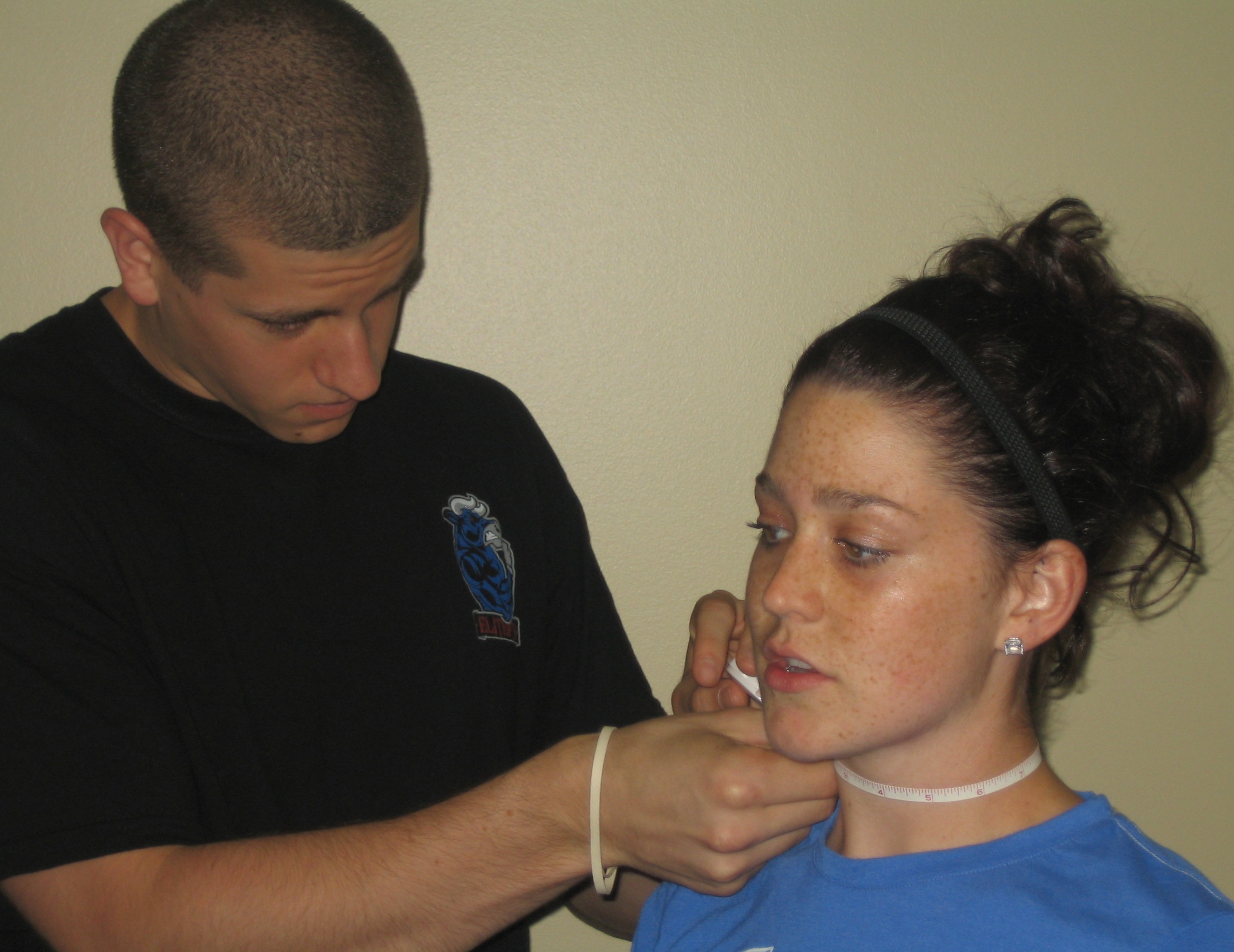
Project Neck- The Female Study
A new study to be published in the Journal of Athletic Training found that in high school soccer, girls sustained this type of head trauma 68 percent more often than boys. Female concussion rates in high school basketball were almost three times higher then boys and the girls took longer to return to play.
When there is an Epidemic in The United States we don’t just inoculate one section of the population we give the antidote to all that need it. In light of research and just common sense our female athletes need to be protected.
Because of physiological differences, women do not have to worry about getting ‘huge’ necks, but they can become very strong. The physics of kinetic energy dissipation applies to females as well as men. The female athlete can protect herself by strengthening the musculature around the cervical spine.
Their training is not dissimilar then the men who train theirs. They train the flexor, extensors and trapezius muscles that allow for increased neck stiffness and high performance moves on the playing field.
Project Neck- The female Study examines the changes both anatomically and morphologically, when resistance training is introduced.
The female subjects will follow the same protocol of their male counterparts used in Project Neck earlier this year.
Females Can Get Strong
Friday, June 3, 2011
Weight Room Charts Send The Wrong Message To Athletes
225 pounds + 75 pounds = 300 pound max
Once a value is assigned to the repetition based upon the study, in this case 0.0333, a ‘Weight Lifting Percentage Chart’ is constructed for the general population.
To use the chart a weightlifter simply finds his or her maximum along the left side. The weight to workout with is taken from the chart based on the percentage and repetitions they are asked to utilize in their workout plan.
Sample of an athletes instructions from the Coach…
Today we are going to use 75% of our maximum for 10 reps, then 85% of our maximum for 6 reps and 90% for 4 on the bench press. The above chart tells you the weight you should be working out with based on your individual max to Get Strong.
The athlete with a 270 max chooses…
75% – 205 x 10
85% – 230 x 6
90% – 245 x 4
Exactly what these percentages really mean to the muscle tissue is a huge question. Weight Charts can be used as guides, yet to be accurate and take into account individual differences you need to make a chart for every exercise and every individual.
Try this to explore the reasoning of many charts…
Find your one repetition maximum in a multi-joint exercise such as a free weight barbell squat or bench press. Select a percentage such as 65%, 75% or 85% of that maximum and do as many repetitions as possible with that percentage and record your repetitions.
Now select a ‘single-joint‘ exercise such as barbell curl and repeat the test. Whether trained or untrained you will find you achieve fewer repetitions at the same percentage of 1RM with a single-joint movement and more repetitions with a multi-joint movement. In other-words multi -joint and single-joint exercises have different values of a repetition. The amount of muscle mass involved in a multi-joint exercise and the neural system alter the outcome.
If this same test is done with a large group of athletes, say a team, you will get a similar result. You will also find a great deal of variability from athlete to athlete in the data.
Try this also……
Take all your athletes who’s maximum is the same in a particular exercise. Let’s say their maximum is 270 pounds on the bench press. Using 75% of their max in the above chart (205), test the maximum amount of repetitions they can do.
In general, most may achieve 10 reps as indicated on the chart, but you may find an athlete who can only do 6 reps or another who can do 15. Very normal stuff, as we all have different neurological efficiencies.
The best chart to hang in your weight room is the ‘Effort Chart’. When you go to it, it says…. give a 100% effort to any weight you choose to….. Get Strong.
Pendulum 3 Way Row
Sunday, April 17, 2011
Monday, February 14, 2011
Strength Train for Performance and Injury Protection
By Dan Riley, M.S.
Strong muscles are good shock absorbers. A strength regimen that strategically builds muscle strength in key areas of the body can provide an extra measure of injury protection on the field.
Strong neck muscles protect against concussion
Injury protection should be a priority, especially at the high school level. The place to start is adding a neck strengthening program into the exercise regimen.
When I was an NFL strength coach, neck machines and shoulder shrugging stations were available, and players were required to train these muscles at the beginning of their workout. Over time, neck “stingers” were nearly eliminated when neck development became the priority.
And with recent news of the dangers of concussion and its long-term cognitive effects, athletes should be encouraged to do all they can to protect themselves from injury.
Strong, shock-absorbing neck muscles help to minimize concussive forces, especially on the football field. Neck strength also protects soccer and baseball athletes from cumulative concussion problems, such as the repetitive impact force of heading the ball.
Thinking long term, machines should be purchased to develop total body strength in all five major body sections:
- Neck and traps (trapezius)
- Hips and legs
- Midsection
- Torso and shoulder capsule
- Arms
In a five-year study with Colorado Rockies baseball pitchers, the strength of the smaller muscles surrounding the shoulder capsule was tested at the beginning of each season. It was determined that if the external rotators of the rotator cuff were weak, or if there was a significant imbalance between the internal and external rotators, the incidence of a shoulder injury was extremely high during the season.
The smaller muscles surrounding the shoulder capsule are designed to protect joint integrity. These muscles include:
- Anterior head (frontal deltoid) – front raise
- Medial head (middle deltoid) – lateral raise
- Posterior head (rear deltoid) – bent-over raise
- Rotator cuff - internal rotation
- Rotator cuff - external rotation
A well-designed strength program should target each of these muscle groups. Multi-joint movement will not generate maximum strength gains in each of these muscles. An isolation exercise for each of these muscles must be performed if maximum strength and protection of the shoulder capsule is the goal.
When I worked with NFL athletes, I found many who had ignored these areas of the body. Some had already been injured and many were extremely deficient in strength in the muscles surrounding the shoulder. Once these muscles groups were targeted, players responded almost immediately.
There is great value in balancing your strength program between protection and performance, but keep in mind: The dangers aren’t just from a catastrophic injury or sudden episode. They may also be the accumulative affect of the repetitive impact forces over time.
Dan Riley, M.S., is a strength and conditioning educator for the Memorial Hermann Sports Medicine Institute with 27 years experience as a strength trainer in the National Football League.
| |||||
Monday, January 24, 2011
Train Year-around
Get Strong
Train Year-round
Train Year-round
The Pendulum Chest Press is an all weather year-round training machine to Get Strong.
Wednesday, January 12, 2011
Every Weight Room Needs a Great Row
Thursday, December 16, 2010
The Ralph Cornwell Files-- Female Neck Training
Ralph Cornwell is a Ph.D. candidate in health promotion/human performance at Virginia Polytechnic Institute and State University. Prior to pursuing his Doctoral Degree he was a collegiate strength coach.
A new study to be published in the Journal of Athletic Training found that in high school soccer, girls sustained this type of head trauma 68 percent more often than boys. Female concussion rates in high school basketball were almost three times higher then boys and the girls took longer to return to play.
When there is an Epidemic in The United States we don’t just inoculate one section of the population we give the antidote to all that need it. In light of research and just common sense our female athletes need to be protected.
There are women athletes that do train their necks.
Their training is not dissimilar then the men who train theirs. They train the flexor, extensors and trapezius muscles that allow for increased neck stiffness and high performance moves on the playing field.
Meagan is a ballerina and is very strong from head to toe.
I asked Meagan why she trained her neck. She simply said, “Ballerinas get put in awkward positions as they perform. If your dance partner drops you while you are being pressed over his head, I want a strong neck.”
Saturday, November 6, 2010
Have We Missed Training Our Hands In Athletics?
Association Of Oldtime Barbell And Strongmen
Attending the AOBS dinner in New Jersey is quite interesting. At the hotel and throughout the evening you have a chance to visit with some of the greatest strength performers throughout the world.
In casual conversations you can learn tips about training. It is fun to listen to the avenues that these athletes take to enhance their enormous strength.
After the dinner ends strongmen bend steel in the lobby of the Marriott until the wee hours of the morning.
This year about 300 people attended to honor the great Dennis Rogers, the Grandmaster of Strongman. Following the reception the young strongmen of America put on quite a show.
They ripped up New York City phone books
They busted baseball bats across their heads
They bent steel while held in their mouths
They rolled up steel
They snapped chains
They drove spikes through 3 inch planks with their hands
What you learn is that we have a long way to go in developing the hand strength of our athletes that play sport. Those that attend to hand strength will change the game. Get Strong!