Showing posts with label neck. Show all posts

Sunday, July 29, 2012

Let's Spring Into Action And Protect Athletes

The Ralph Cornwell Files

Let's Spring Into Action And Protect Athletes                                              
describe the imageRalph Cornwell is a Ph.D. candidate in health promotion/human performance at Virginia Polytechnic Institute and State University. Prior to pursuing his Doctoral Degree he was a collegiate strength coach.
spring
Research from the best minds in the automotive safety industry  all agree, the circumference of the neck changes the way it reacts to forces applied to that area.
The former Congressional appointed Chairman of the Head  and Neck Committee put together a study on concussions and found: " Stronger necks reduce head acceleration, deltaV, and displacement. Even relatively small reductions in deltaV have a large effect on head injury criterion that may reduce concussion risks because changes in deltaV change head injury criterion through the 4th power."
Test dummies are used to simulate a human in a collision whether it is by automobile or playing sports.
spring1

How do they simulate neck strength in humans?

They change the size of the spring on the test dummies. Small to replicate a child’s neck circumference.  Medium size for female adults and large for adult males.
spring2
To simulate an athlete’s neck you have to go one step further.  The athlete’s neck is simulated by the largest and most stiff spring on a crash dummy in order to replicate the kinematics of a collision accurately.
spring3

The replicated athletic neck is more resistant to change than the mock-up normal population neck.  It  deforms less then all the simulated necks.
spring4

This is true for crash test dummies; is it not true for athletes playing sports that include collisions?
By increasing the circumference of our athlete’s necks the same result should occur. Less deformation of the cervical spine.
spring5
If this is good for test dummies, it should be good for America’s athletes risking concussion during sports. It will certainly lowers the subconcussive forces.
 spring6
Congress calls concussions an 'American Epidemic'. Let’s start inoculating our athletes with larger stronger necks.www.concussionpreventionprotocol.com

Sunday, December 4, 2011

Intelligent Exercise-Project Neck | LinkedIn

Intelligent Exercise-Project Neck | LinkedIn


Female Study Results

Best Only One female showed any muscle hypertrophy or muscle growth that induced neck circumference increase. The increase was 1/32 of an inch
Neck Ext 45lbs
Neck Flex 45lbs
Neutral Grip Row 185 Pounds
Bilateral Shrug 150 Pounds
Levator Scapulae 140lbs

Worst

Neck Ext 35lbs
Neck Flex 35lbs
Neutral Grip Row 140 Pounds
Bilateral Shrug 80 Pounds
Levator Scapulae
80 Pounds

Monday, June 13, 2011

Project Neck- The Female Study

Project Neck- The Female Study
According to a study published in the Journal of Athletic Training in 2007, female high school athletes suffered almost 40 percent more concussions than males did. It estimated that female players suffer about 29,000 concussions annually with boys suffering 21,000.

A new study to be published in the Journal of Athletic Training found that in high school soccer, girls sustained this type of head trauma 68 percent more often than boys. Female concussion rates in high school basketball were almost three times higher then boys and the girls took longer to return to play.

When there is an Epidemic in The United States we don’t just inoculate one section of the population we give the antidote to all that need it. In light of research and just common sense our female athletes need to be protected.

Because of physiological differences, women do not have to worry about getting ‘huge’ necks, but they can become very strong. The physics of kinetic energy dissipation applies to females as well as men. The female athlete can protect herself by strengthening the musculature around the cervical spine.


Their  training is not dissimilar then the men who train theirs. They train  the flexor, extensors and trapezius muscles that allow for increased neck stiffness and high performance moves on the playing field.


Project Neck- The female Study examines the changes both anatomically and morphologically, when resistance training is introduced.


The female subjects will follow the same protocol of their male counterparts used in Project Neck earlier this year.


Females Can Get Strong

Tuesday, April 19, 2011

Students participate in study to lower concussive and subconcussive forces

Every 20 minutes, a different young man enters a small room in Elon University’s Koury Athletic Center looking energetic, and 20 minutes later the same man exits the room dripping and red-faced. These students aren’t shaping their calves on treadmills or curling their biceps – they’re strengthening their necks.
Each Monday, Wednesday and Friday for the past four weeks, 11 students have been visiting this little room, getting their necks measured and pumping iron with the part of the body few incorporate into their exercise routine. The students are subjects of Ralph Cornwell’s study, “Project Neck,” which researches the effects of consistent neck conditioning, with the goal of preventing damage from concussions.
Cornwell, a Ph.D. candidate in health promotion/human performance at Virginia Polytechnic Institute and State University, is conducting what is — as far as anyone knows — the only study aimed at preventing concussions, instead of fixing them after they occur. His research will also create a neck-strengthening protocol to which Cornwell hopes strength and conditioning coaches will have to adhere in the future.
“This will be the culmination of (my) doctoral dissertation,” said Cornwell. He’s performing his research at Elon because he lives in Greensboro and said, “The atmosphere here is very conducive to learning and experimentation. You get better quality.”
For the dissertation, Cornwell said he will apply the laws of physics to his research’s resulting statistics, and construct a mathematical model that will show the different outcomes of concussion-inducing forces on people who followed his protocol, and those who did not. He said this is the only way to measure the differences without hitting his subjects over the head, which he’s not about to do.
The idea is that the muscles of a strengthened neck will disperse the kinetic energy of a hard force. “The stronger your neck is, the more likely it is to dissipate the energy from a blow,” said Matt Kavalek, Cornwell’s lead research assistant and a sophomore at Elon.
Stronger neck and back muscles would mean increased support, decreasing the odds of a blow jarring the brain inside the skull after a hard blow, which causes a concussion. Cornwell likened strengthened neck and back muscles to an organic “cowboy collar” used by football players for neck support.
Cornwell and Kavalek are already four weeks into the study and are seeing results in the 11 students following the strict protocol Cornwell developed. Three devices are used, two of which are still prototypical, for various exercises focusing on the muscles in the neck or back.
Kavalek said Cornwell worked with anatomists at Wake Forest University to make sure each movement of every exercise has a direct effect on a key neck or back muscle. The exercises include the “tilt,” the “nod,” “laterals,” the “shrug,” the “shrug with head turn,” the “Kelso” and the “Hise shrug.”
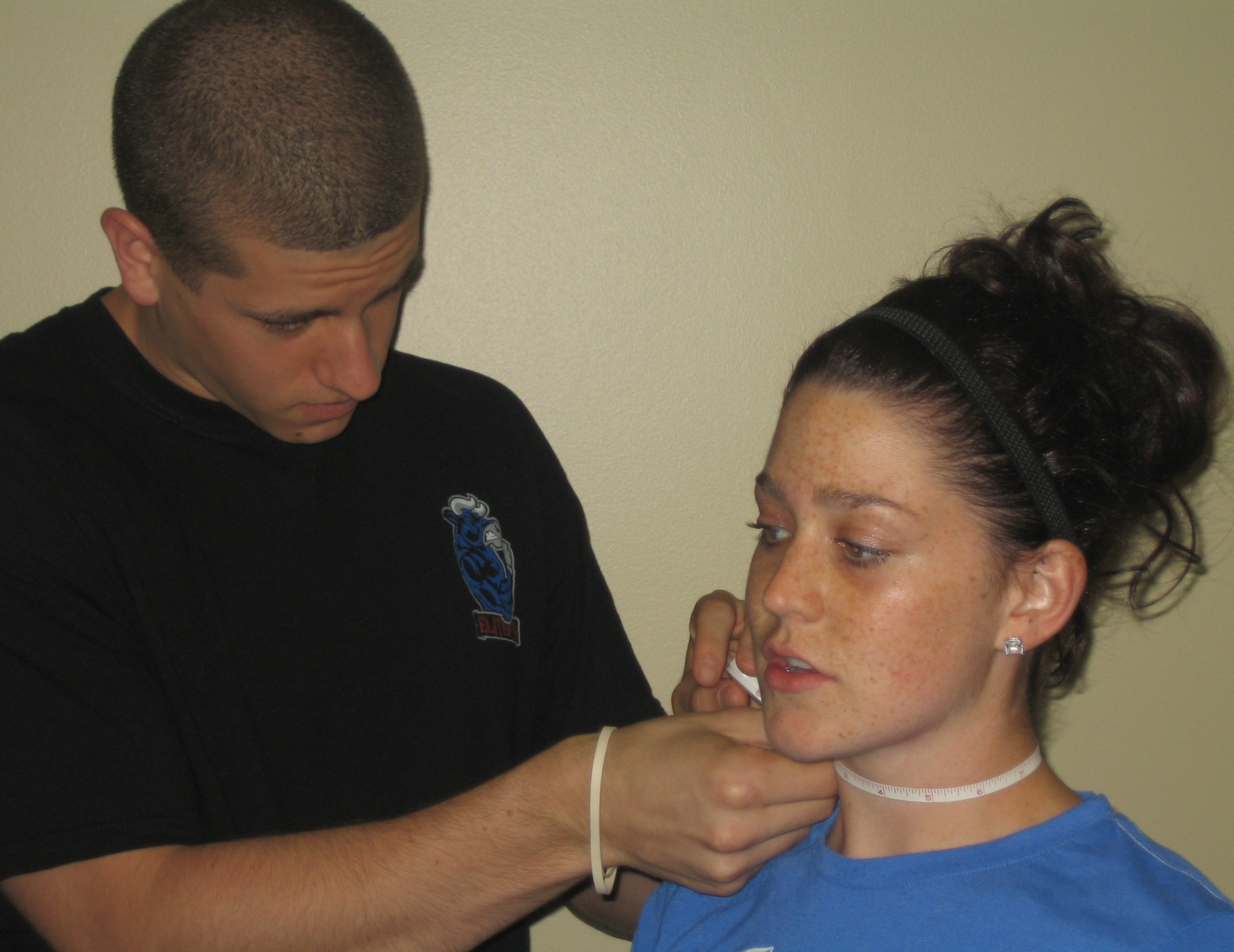
But before a study participant launches into his first set of head tilts, Kavalek measures the circumference of his neck, which increases as the muscles gain strength. The study uses only male Elon students, since men aged 18-24 create the best test pool for measurable neck gain, said Cornwell. Since women don’t have the same high testosterone levels as men, their necks wouldn’t get thicker if they did the exercises, and Cornwell’s study needed a physical way to measure progress.
After having his neck measured, the study participant sits in the first prototypical device, a five-way neck machine, and rests the back of his head against a cushion. “It’s the only machine where you can train the muscles in the head and the neck,” said Cornwell. The subject performs the “tilt” and tips his head backward just 25 degrees, which works only the capital muscles — the neck muscles connected to the first two vertebra of the spine — and not the back muscles.
“It’s such a subtle movement, but the back of his head will be on fire,” said Cornwell, as Kavalek counted out 12 repetitions. The subject’s neck is burning because he’s literally lifting weights with his neck. At first, every participant starts each exercise with 10 pounds, but Cornwell increases the weight in increments after the student is able to complete a set with 10 pounds, then 15, and so on.
“We needed a baseline everyone could complete,” said Cornwell. “All the movements are slow and patrolled, so no one gets hurt.” He and Kavalek spot the test subject as he moves onto the “nod,” which is a 10-degree movement forward, as if “you’re acknowledging a friend,” said Cornwell. Then the student performs “laterals,” which is the same movement but to the left and right sides instead of forward.
The next movements, also on the five-way neck machine, target the trapezius – the muscle spanning the neck, shoulders and back, and reaching all the way down to the thoracic (twelfth) vertebrae. The subject performs a “shrug,” and then a “shrug with head turn,” turning the uppermost part of the trapezius, which Cornwell explained happens naturally when you pick up something heavy in a shrug position.
Fifteen seconds after the last set of shrugs, the subject moves to the three-way row machine for the “Kelso,” which is a movement pulling the scapula together and works all the muscles in the back. It’s the movement that test subject Thomas Emery, a sophomore majoring in psychology, said is his least favorite. “You feel it everywhere in your back,” he said.
As Emery fights losing his grips on the machine’s handles during his “Kelso” set, Kavalek cheers him on. “You’re almost there. This is your best set ever. You just need to get angry.” Sweat drips from Emery’s chin as Cornwell moves him to his last movement, the “Hise shrug.” Using squat bar equipment, Emery shrugs with the weighted bar across his back, again targeting his trapezius.
At the end of his training session, Emery is out of breath, which Cornwell said is the norm for most participants. He said he thinks many assumed training one’s neck would be easy, but found out after signing up for the study that it’s not. Kavalek compares the exercises to training a bicep: “If you put (your muscles) against a load, they’re going to get stronger.”
Despite the difficulty, Emery plans to continue neck-strengthening exercises even after the study is completed in another four weeks. And it’s Cornwell’s hope that the exercises Emery and the 10 other Elon students are performing will become part of a protocol required by certifying sports organizations, and will eventually trickle down to the high school and middle school level.
“It’s not an easy protocol by any means,” Cornwell said. But, since no other protocols for preventing concussions exist – in the athletic arena or otherwise – he said, “At least (it will) give them something to go on.”

Sunday, March 20, 2011

If You Do Not Train It - Do Not Expect It To Grow

If You Do Not Train It - Do Not Expect It To Grow

 
If You Do Not Train The Muscles Of The Head And Neck Do Not Expect Them To Grow                                                        
If you travel America and discuss neck training with coaches and athletes many believe they are getting sufficient neck development by doing pulls, as well as, shrugs.
mriIn a study that was published in the Journal of Applied Physiology.  They trained two groups exactly the same with the exception that one group trained their neck extensors three days per week.  The researchers examined the neck musculature with an MRI and looked at the cross sectional area of ten muscles and their growth.
mri1Only the group that strength trained their neck Monday, Wednesday and Friday made muscular gains of the cervical  musculature.  The researchers clearly saw the results through magnetic resonance imaging.


Both Groups on Sunday and Wednesday performed sets of

Parallel Squat
Push Press
Bench Press
Crunch Exercises
Both Groups on Monday and Thursday performed sets of

Pulls from the Mid-Thigh
Romanian Deadlifts
Bent Rows
Crunches
Monday, Wednesday and Friday
Only one Group did neck extensions 3 sets of 10.
The study continued for 12 weeks and made it clear that a resistance exercise program does not provide stimulus for cervical adaptations unless specific neck exercises are performed.
Train your head and neck to Get Strong.
mri2
Tags: 

Strengthen The Head And Jaw

Strengthen The Head And Jaw
flex1
The infrahyoids are made up of four muscles; three of which attach to the hyoid bone, the omohyoid, the sternohyoid, and the thyrohyoid.  They lie right over the trachea.  The infrahyoids can be and are often damaged in whiplash.
Infrahyoids: flex the neck.
Suprahyoids: open the jaw.
The hyoids are involved in chewing and movements of the tongue.
The hyoids are heavily involved in posture and a weakness in these muscles can cause many interesting problems from how we stand, how our back feels to cervical neck pains.
What is interesting is that the suprahyoid and infrahyoid muscles attach to the hyoid bone, the only free floating bone in our body.
hyoid
describe the imageMusculature attaching above and below this free floating structure allows for a dampening effect that helps limit oscillations of the head.

In physics, damping is any effect that tends to reduce the amplitude of oscillations and the hyoids can act as a damping device.

Using the specialized cam on the Pendulum 5 Way Neck or… new… 4 Way Neck allows an athlete to isolate these natural force dissipators.
flex2
Train the muscles that move and protect the Head as well as train the Neck muscles, Get your athletes Strong.
flex


Tatum High School Weight Room,Tatum Texas
texas

tatum

Saturday, March 19, 2011

Project Neck Expands to Elon University

Ralph Cornwell, Jr. PhD. Candidate from Virginia Tech announced today of the expansion of his research study looking at lowering concussive and subconcussive forces with anatomical changes to the  neck, trapezius and upper back , accomplished through resistance training.

Cornwell’s research appropriately named Project Neck,  is charged with creating a protocol that an athlete can use to lower concussive and subconcussive forces. Cornwell is using state of the art Pendulum equipment from Rogers Athletic.                                                                                                                                                                                      
Project Neck expanded it’s research from Virginia Tech to Elon University, located in North Carolina. Cornwell is working in conjunction with Elon professors Dr. Eric Hall and Dr. Paul Miller of the Neuroscience Department at Elon University.


Dr. Eric Hall       Dr. Paul Miller
Project Neck is the only study looking at preventative sports medicine. Addressing the concussive and subconcussive forces before the athlete concusses. A great amount of research is  ongoing at several universities in the United States involving concussion treatment and cause and effect. Project Neck, to the best of my knowledge, is the only proactive research study examining  the effects of anatomical and morphological changes in the human body and how these changes lower those forces.

The 8 week research study will use a protocol that involves hypertrophy of the muscles of the head and neck. The protocol also addresses the trapezius and the muscles of the upper back. Cornwell is also looking for circumference changes in the upper and lower regions of the neck. Baseline measurements taken at the beginning of the research will be compared to measurements  at the completion of the study.  Strength increases in the head and neck region will also be recorded each training session. The adaptations to the head and neck will increase the stiffness level of that area making for a more resilient athlete.
Lead Research Assistant Matt Kavalek takes baseline measurements
Cornwell’s hope is to create a basic protocol that  coaches of athletes or even  parents could use to help combat what The Center of Disease Control and Prevention calls a National Concussion Epidemic. Cornwell explains, “the only way to stop concussions in athletes is to stop playing their particular sport. If we can not stop concussions then we must prepare our athletes,youth to professional, for the rigors of their sport.” The process is really a combination of the best helmets, mouth pieces and coaching technique. The variable that I believe we are overlooking is the head and neck. An athlete can still sustain a concussion even while wearing a helmet.

The stronger athlete will be better prepared for contact or collision. Subcocussive forces are also a health problem that must be addressed. The low level bumps and dings an athlete receives in any given season can be a cause for concern later in life. Research has shown that subcocussive forces can cause long term brain injuries well after the athlete stops playing competitive sports. Concussions can be caused by the accumulation of these small hits too. When we watch sporting events on television it would make sense that the extremely hard collisions  we view would be the culprit of the concussion crisis. This not the case, as further research is conducted, scientists are finding the subconcussive forces to be just as damaging as the violent collisions. The problem with subconcussive forces is this; you don’t always notice them as an athlete playing a sport or as a coach observing a practice or game.

The Centers for Disease Control and Prevention along with the National Institute of Health agree that America has a National Concussion Epidemic. These two goverment agencies are only called upon when there is a health crisis or problem with our food supply on a national level. If there were a Flu Epidemic, scientists would work towards a vaccine and begin inoculating the population with a cure. The Concussion Epidemic has been dealt with in a different manner. Researcher observe the cause of concussions and study how to best treat a concussion after the person has injured his or her brain.

Cornwell’s research takes a different approach towards the concussion epidemic. He believes we should inoculate our youth playing sports and their college and professional counterparts. Cornwell explains, ” I do not believe we are curing the concussion problem in America with any protocol designed to give the athlete the ability to lower  concussive forces. What I do believe is this, if we do nothing we are not giving our athletes any means of  resistance to concussive or subconcussive forces. If  my study helps to lower concussive forces  by 1 percent, it is a step in the right direction. If we raise the level by which subconcussive  forces can not harm the brain, this is also a step in the right direction.”

Project Neck’s protocol is time efficient, purposeful and presumed effective. The protocol can be performed in under 20 minutes twice a week. This is not a large amount of time out of an athletes day when we are concerned with brain injury.  I want this simple study to be the genius of larger research studies looking at protecting the athlete first and foremost. Researchers, athletic trainers and coaches will tell you we can do nothing to protect our athletes. If my research proves nothing at all but spurs on further research, then what harm was done? That’s what science is all about, the search for the truth.
I would like to thanks Dr. Hall and Dr. Miller for their support. I would also like to thank Elon University for allowing me to use their facilities and their generous hospitality.

Monday, February 14, 2011

Strength Train for Performance and Injury Protection

Strength Train for Performance and Injury Protection
By Dan Riley, M.S.

As the science of strength training has evolved over the past 20 years, unfortunately weight room equipment has not kept pace. Most available machines are great for training a weight lifting team, or to improve athletic performance – but sports athletes need more.
Strong muscles are good shock absorbers. A strength regimen that strategically builds muscle strength in key areas of the body can provide an extra measure of injury protection on the field.
Strong neck muscles protect against concussion
Injury protection should be a priority, especially at the high school level. The place to start is adding a neck strengthening program into the exercise regimen.
When I was an NFL strength coach, neck machines and shoulder shrugging stations were available, and players were required to train these muscles at the beginning of their workout. Over time, neck “stingers” were nearly eliminated when neck development became the priority.
And with recent news of the dangers of concussion and its long-term cognitive effects, athletes should be encouraged to do all they can to protect themselves from injury.
Strong, shock-absorbing neck muscles help to minimize concussive forces, especially on the football field. Neck strength also protects soccer and baseball athletes from cumulative concussion problems, such as the repetitive impact force of heading the ball.
Thinking long term, machines should be purchased to develop total body strength in all five major body sections:
  1. Neck and traps (trapezius)
  2. Hips and legs
  3. Midsection
  4. Torso and shoulder capsule
  5. Arms
Strong shoulder muscles protect joints, tendons and ligaments
In a five-year study with Colorado Rockies baseball pitchers, the strength of the smaller muscles surrounding the shoulder capsule was tested at the beginning of each season. It was determined that if the external rotators of the rotator cuff were weak, or if there was a significant imbalance between the internal and external rotators, the incidence of a shoulder injury was extremely high during the season.
The smaller muscles surrounding the shoulder capsule are designed to protect joint integrity. These muscles include:
  • Anterior head (frontal deltoid) – front raise
  • Medial head (middle deltoid) – lateral raise
  • Posterior head (rear deltoid) – bent-over raise
  • Rotator cuff - internal rotation
  • Rotator cuff - external rotation
The rear deltoid muscle is designed to decelerate the arm in any throwing motion. Quarterbacks, softball and baseball players, javelin throwers, etc., often complain of soreness or injury in this area.
A well-designed strength program should target each of these muscle groups. Multi-joint movement will not generate maximum strength gains in each of these muscles. An isolation exercise for each of these muscles must be performed if maximum strength and protection of the shoulder capsule is the goal.
When I worked with NFL athletes, I found many who had ignored these areas of the body. Some had already been injured and many were extremely deficient in strength in the muscles surrounding the shoulder. Once these muscles groups were targeted, players responded almost immediately.
There is great value in balancing your strength program between protection and performance, but keep in mind:  The dangers aren’t just from a catastrophic injury or sudden episode. They may also be the accumulative affect of the repetitive impact forces over time.
Dan Riley, M.S., is a strength and conditioning educator for the Memorial Hermann Sports Medicine Institute with 27 years experience as a strength trainer in the National Football League.
Sports Medicine Institute Medical Staff


Saturday, February 5, 2011

Train The Head And Neck

Train The Head Neck & Traps


Train The Head Neck And Traps                                              
1). Nod 10 Degrees
describe the imagedescribe the image
2). Tilt 25 Degrees
describe the imagedescribe the image
3). Neck Flexion
describe the imagedescribe the image

4). Right Side Of Neck
describe the image
5). Left Side Of Neck
describe the image
6). Neck Extension
describe the imagedescribe the image
7). One Arm High Shrug
describe the image
8). Two Arm Shrug
shrug

9). Underhand Row With Scapular Retraction
describe the image

10). Seated One Arm Overhead Press
low trapdescribe the image

Comments